Coffin Joe
Brazil did not need a castle in Transylvania. It had a cemetery, a black top hat, a pair of impossible fingernails, and José Mojica Marins staring into the camera as if he had personally caught the audience trespassing.
That was enough.
Zé do Caixão — known abroad as Coffin Joe — is one of those characters who seem too complete to have been invented. He looks like folklore that has always existed: undertaker, blasphemer, philosopher, sadist, carnival barker, village tyrant. But he came from one man, one nightmare, and a kind of Brazilian cinema that had almost no money and absolutely no interest in asking permission.
What fascinates me about José Mojica Marins is not only that he created Brazil's greatest horror icon. It is that he built an entire mythology with whatever was available. Cheap sets. Amateur performers. Real animals. Television studios. Censored footage. His own face. His own nails. If an elegant production system did not exist for the films he wanted to make, he simply crawled under the system and kept filming from there.
A Boy Who Grew Up Inside a Cinema #
Mojica was born in São Paulo on March 13, 1936. A Friday the 13th, naturally. If a publicist had invented that detail later, it would feel embarrassingly obvious. Reality was less subtle.
His father managed a neighborhood movie theater, and the family lived in the same building. Mojica spent his childhood close to the projection room, surrounded by reels, shadows, posters, and the mechanical rhythm of films passing through a projector. Cinema was not an occasional event for him. It was the architecture of the house.
At twelve, he received an 8mm camera and began making films with relatives, neighbors, and anyone willing to stand in front of the lens. He exhibited those early productions wherever he could and charged small admissions to recover the costs. By his late teens, he had founded an acting school and a small film company. The school supplied performers, trained technicians, and helped finance the next production. It was less an institution than a self-sustaining cinematic organism.
Before horror, he tried westerns, adventures, melodramas, and other popular genres. His first completed feature, A Sina do Aventureiro (The Adventurer's Fate, 1958), was a Brazilian western assembled with the same stubborn independence that would define the rest of his career. Mojica was not waiting to be invited into an established industry. He was manufacturing an industry around himself.
This matters because Zé do Caixão did not emerge from a comfortable studio searching for a marketable monster. He emerged from necessity. Mojica needed a character strong enough to survive poverty, censorship, bad equipment, skeptical actors, and audiences who had never seen a Brazilian horror film before.
So he made someone impossible to ignore.
The Nightmare That Became Zé do Caixão #
Mojica said the character arrived in a nightmare in 1963. A dark figure dragged him from his bed and carried him toward a grave. Inside the grave, Mojica saw his own body waiting in a coffin. He woke up terrified and began developing the story that became À Meia-Noite Levarei Sua Alma — At Midnight I'll Take Your Soul.
The dream explains the visual shell, but the character became much stranger than a simple supernatural undertaker. Zé is not Dracula, a ghost, or a demon. He is a human being who has decided that conventional morality is a weakness. He despises religion, mocks superstition, terrorizes his neighbors, and believes that the only form of immortality is “the continuation of blood”: producing a perfect son with the perfect woman.
Naturally, everyone around him becomes disposable.

Poster for At Midnight I'll Take Your Soul. Artwork © its respective rights holders, remotely displayed for identification and editorial commentary.
Released in 1964, At Midnight I'll Take Your Soul is widely regarded as the first Brazilian horror feature. It is raw, theatrical, angry, and much more inventive than its limited resources should allow. The film does not politely introduce Zé. He addresses the audience, challenges God, eats meat on Good Friday while a religious procession passes, assaults people who irritate him, and murders anyone obstructing his search for an heir.
There is something almost punk about the film, although it predates punk by more than a decade. It attacks social and religious authority, but it does not replace them with a clean political program. Zé's rebellion is selfish, violent, and grotesque. He is not a misunderstood hero. He is the nightmare produced when absolute individualism loses the last trace of compassion.
And yet he is magnetic.
That is Mojica's trick. Zé is horrible, but never dull. He enters a room and changes its temperature. The hat makes him taller. The cape gives him the silhouette of a nineteenth-century villain who somehow wandered into a poor Brazilian town. The beard, rings, and fingernails push him toward caricature, but Mojica's eyes pull him back into danger. He does not merely look at other characters. He seems to accuse them of being alive incorrectly.

José Mojica Marins as Zé do Caixão in At Midnight I'll Take Your Soul. Film still hosted by the British Film Institute; image © its respective rights holders.
The Most Brazilian Thing About Him #
Calling the character “Brazilian Dracula” is convenient, but it misses what makes him special. Zé has no aristocratic castle and no ancient European bloodline. He is a local undertaker. He lives among ordinary people, argues with villagers, humiliates the faithful, and uses the daily intimacy of a small community as a weapon.
The horror is not visiting from somewhere else. It already owns a business in town.
Mojica borrowed the visual confidence of classic horror, but he filled it with Brazilian tensions: Catholic ritual, popular superstition, poverty, social hierarchy, masculine arrogance, and the constant friction between official respectability and the violence underneath it. The films feel handmade because they were handmade, but that roughness is not merely a technical deficiency. It gives them texture. Their world seems dirty enough to leave residue on the viewer.
The first film was a commercial success despite financial trouble and even ridicule from people around the production. Zé quickly escaped the screen. He appeared in comic books, records, television programs, public events, and eventually advertising. Mojica and the character became so closely fused that many Brazilians simply called the director Zé do Caixão.
It is one of the strangest victories in cinema: the monster ate the name of his creator, and the creator seemed delighted to keep feeding him.
Hell Suddenly Has Color #
Mojica continued the story with Esta Noite Encarnarei no Teu Cadáver — This Night I'll Possess Your Corpse — released in 1967. Zé survives the punishment at the end of the first film and resumes his search for the woman capable of bearing his “superior” child. His methods become more elaborate and more cruel. Women are abducted and subjected to tests involving snakes and spiders. The philosophical speeches grow larger. So does the madness.

Poster for This Night I'll Possess Your Corpse. Artwork © its respective rights holders, remotely displayed for identification and editorial commentary.
The film is mostly black and white, but its famous vision of Hell erupts into color. It is a beautiful decision because the color does not make the sequence more realistic. It makes it less stable. Bodies twist among crude, painted landscapes and impossible shapes. The limited production values stop being a weakness and become the logic of a fever dream.
Mojica often used real animals. The spiders, snakes, rats, and cockroaches were not polite effects added later. In a 2009 interview, he explained that he would submit himself to the animals during rehearsals before asking actors to do the same. This does not make the working conditions easy to defend by modern standards, but it complicates the popular image of Mojica standing safely behind the camera while terrorizing everyone else. He wanted the ordeal to be physical, and he put his own body into it.
The censorship was just as real. Mojica worked through the Brazilian military dictatorship, when blasphemy, sexuality, drugs, and attacks on moral authority attracted official attention. The ending of This Night I'll Possess Your Corpse was forced toward a religious concession that contradicted Zé's philosophy. Decades later, Mojica described Embodiment of Evil as a chance to let the character finally stand against what the censors had demanded.
The state could cut the film. It could not make the character obedient.
The Film the Dictatorship Tried to Bury #
Zé do Caixão was Mojica's most famous creation, but Mojica was more than the caretaker of a single franchise. He made anthology horror, westerns, social satires, erotic films, hallucinations, and works that barely fit into any stable category.
One of the most fascinating is O Ritual dos Sádicos, later renamed O Despertar da Besta — Awakening of the Beast. Completed around 1970, it mixes documentary-style discussions of drugs and social decay with dramatized violence and an LSD experiment built around the image of Zé do Caixão. The federal censors rejected it. The film remained prohibited for roughly fifteen years and was only released in the 1980s under its new title.
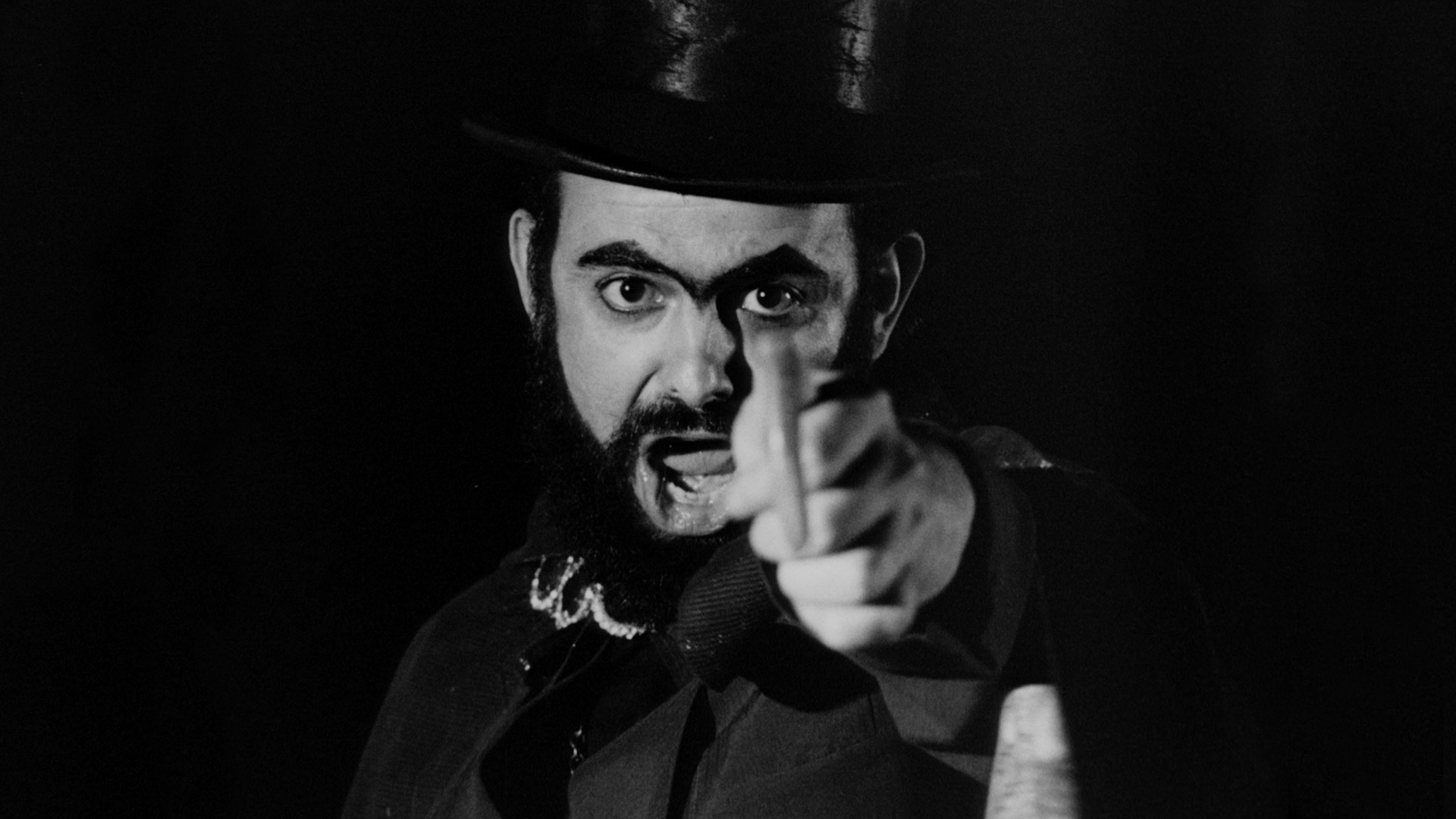
Scene from Awakening of the Beast, presented by Instituto Moreira Salles as part of its José Mojica Marins restoration program. Image © its respective rights holders.
There is a dark joke hiding in that history. A government obsessed with protecting society from dangerous images turned a low-budget filmmaker into forbidden mythology. Mojica already understood how publicity worked. Censorship merely gave him another costume.
He also brought horror into Brazilian homes. Beginning in the late 1960s, he appeared as Zé do Caixão on television, introducing and performing horror stories. Many recordings were later erased or reused, leaving a painful gap in Brazilian television history. In the 1990s, a new generation encountered him through Cine Trash, where he presented horror movies on TV Bandeirantes. He was no longer only a film character. He was a host, a mascot, and a familiar intruder in the afternoon schedule.
Outside Brazil, the rediscovery took longer. In the mid-1990s, American cult-video audiences began finding Mojica through VHS releases. The English name Coffin Joe helped package the character, but the films remained stubbornly themselves: Portuguese-speaking, Catholic-haunted, cheap, theatrical, and unmistakably Brazilian. What foreign viewers treated as a bizarre new discovery had already been living in Brazil's cultural basement for three decades.
Forty-Four Years to Finish a Trilogy #
The third official chapter, Encarnação do Demônio — Embodiment of Evil — arrived in 2008, forty-four years after the first film. That gap alone makes the trilogy extraordinary. The same filmmaker returned to the same character not as a nostalgic cameo, but as an old man still determined to complete an argument interrupted by censorship, money, lost rights, and time.
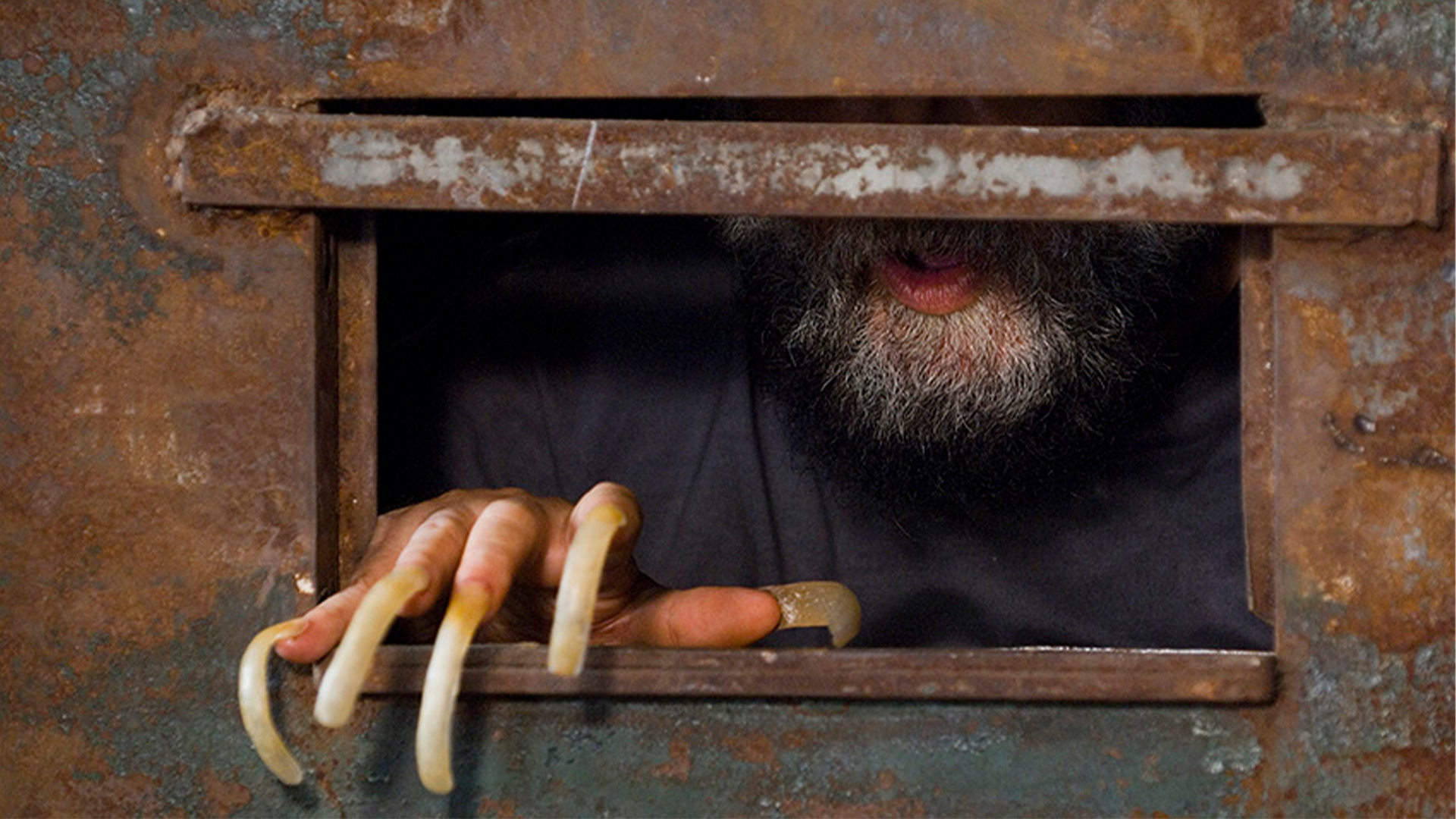
Official promotional artwork for Embodiment of Evil, remotely hosted by Gullane. Artwork © its respective rights holders.
In the film, Zé is released after forty years in a prison psychiatric ward and returns to a modern São Paulo that has changed without becoming less violent. He resumes his search for the perfect woman and the continuation of his blood. The production is larger, the effects are more explicit, and the filmmaking is technically polished, but Mojica does not domesticate the character for a respectable comeback.
The movie also contains a moving production story. Veteran actor Jece Valadão became seriously ill during filming and died before completing his role. Rather than replace him and erase his final work, Mojica insisted that Valadão remain in the movie. The screenplay was restructured around the footage already filmed. For a director famous for cruelty on screen, it was a deeply loyal decision behind the camera.
And then there were the tarantulas. This time Mojica let them crawl across his own face on camera, partly as an answer to decades of accusations that he made performers endure things he would not face himself. At more than seventy years old, he was still proving the point physically. Sensible? Perhaps not. Consistent? Completely.
A Filmmaker Too Large for “So Bad It's Good” #
Mojica spent years being dismissed as trash, exploitation, incompetence, or accidental comedy. Some of the films are uneven. Some effects are visibly improvised. Performances can swing from stiff to hysterical inside the same scene. But “so bad it's good” is a lazy way to describe an artist who knew exactly how to create an image people could not forget.
He understood faces, silhouettes, ritual, repetition, and confrontation. He understood that the camera could be addressed directly, almost assaulted. He understood that a limited set becomes convincing when the actor inside it behaves as if the universe ends at the wall. Most importantly, he understood that horror does not require permission from realism.
The films have humor, but they are not jokes. Their roughness belongs to the conditions that produced them and to Mojica's refusal to wait for better conditions. He was making personal genre cinema in Brazil before the cultural gatekeepers had a comfortable category for it. While more prestigious movements received academic respect, Mojica reached popular audiences and built an icon from the margins.
Today his work is being restored in 4K from original materials, screened by institutions such as the Instituto Moreira Salles and the BFI, and reconsidered as a central part of Brazilian and world horror cinema. The restoration is important because poor VHS copies shaped the international reputation of these films for years. Mojica's darkness was intentional. The mud was not always supposed to be there.
José Mojica Marins died in São Paulo in 2020, at the age of 83, from complications of bronchopneumonia. Zé do Caixão survived him, of course. Characters built around immortality tend to be annoying that way.
But I think the real continuation of blood was never the perfect son Zé kept demanding. It was the filmmakers Mojica influenced, the audiences he disturbed, the images he planted in Brazilian culture, and the proof that horror made here did not need to imitate anyone politely.
Brazil did not inherit Zé do Caixão from an old legend.
Mojica made the legend himself.