finger hi@pablomurad.com
Long before profiles, status updates and the little green dot that says someone is online, there was finger. Typing finger someone@somewhere in a terminal brought back who that person was, whether they were logged in right now, when they last read their mail, and a few lines they had written about themselves in a file called .plan.
It still works:
finger hi@pablomurad.com
A program at Stanford #
Les Earnest wrote the first finger program in 1971, for WAITS, the time-sharing system at the Stanford Artificial Intelligence Laboratory. On a computer shared by many people, it answered a simple question: who else is here?
Once those computers were connected to the ARPANET, people wanted to ask the same question about other machines. In December 1977, RFC 742 described finger as a network protocol. The version still in use is RFC 1288, "The Finger User Information Protocol", written by David Zimmerman at Rutgers and published in December 1991.
The whole protocol in one paragraph #
A finger server listens on TCP port 79. The client connects and sends one line of text ending in a carriage return and a line feed,1 and the server answers with plain text and closes the connection. There's no login and no headers, and the client never gets to ask a second question on the same connection.
What goes in that one line changes the answer:
an empty line: list the users logged in right now username: tell me about this user /W username: the same, with more detail (servers are free to ignore the /W) username@host2: please ask host2 for me, and pass on the answer
A finger program isn't even needed. nc does the job, as long as the carriage return goes along. This is runv.club, the pubnix I run, answering an empty line:
$ printf '\r\n' | nc runv.club 79 runv.club, a small public unix server. https://runv.club/
on now: nobody members: 8
finger name@runv.club for someone's plan
The last form in that list, user@host2 sent to host1, is forwarding: host1 connects to host2 on the client's behalf. It sounds harmless, but it lets anyone bounce queries through the server, so RFC 1288 already recommended refusing it by default in 1991. Mine doesn't forward. This is what it says to anyone who tries:
$ printf 'root@sdf.org\r\n' | nc pablomurad.com 79 This host publishes two Finger addresses:
hi@pablomurad.com sky@observatorium.thatsmy.tools
The .plan file #
Fingering a user on a Unix machine made the server read two files from their home directory and print them at the end: .project, usually one line about what they were working on, and .plan, which could be anything at all.
People used the .plan for what we'd later use a status, a microblog or a "now" page for: what they were doing this week, where they'd be, a joke, a quote, a drawing made of characters. Since it was just a text file, updating it meant editing the file, and everyone who fingered its owner got the new version.
The most famous .plan files belonged to John Carmack at id Software, who wrote development notes about the studio's games in his for years. Fans fingered him to read them, and archives of his .plan files, starting in 1996, are still passed around today.
Mine starts like this:
Login: hi Name: Pablo Murad Directory: /home/hi Shell: /bin/bash On since Sat Nov 21 22:15 (-03) on pico 10 minutes idle Project: Independent web projects, decentralized networks, Unix and experimental Internet protocols. Plan: Building runv.club, a small public Unix server from Brazil.
After that comes a skull drawn in ASCII, a short introduction, and three sections: NOW, with my latest short posts, LATEST POSTS, with what I've published here, and ELSEWHERE, with the other ways to reach me, including talk hi@pablomurad.com for anyone who still has a talk client. The last line says when it was updated. Through a web gateway, the whole page looks like this:
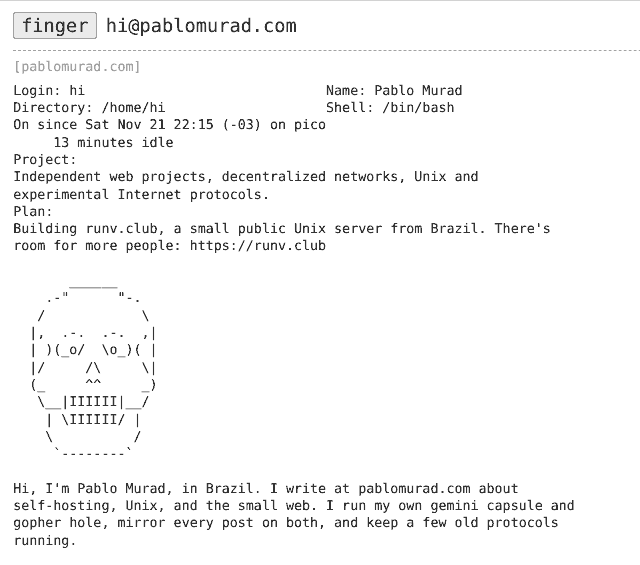
The "On since" line is new. A classic finger server only says that when you're logged in to a terminal, and I almost never am, so mine now reads it from the last time the plan was rebuilt. How that works, and how a talk call ends up ringing my phone, is in How finger and talk work at hi@pablomurad.com.
What finger got used for, and why it faded #
Finger got used for things nobody planned. In 1982, a group at Carnegie Mellon wired the Coke machine down the hall to their computer and added it to the finger program. Anyone on the ARPANET could check whether there were bottles left, and which ones had been in long enough to be cold, before walking down the stairs. It's often called the first internet of things device.
The same openness made finger a target. In November 1988, the Morris worm, one of the first worms to spread across the internet, used a buffer overflow in fingerd, the finger server, as one of its ways into machines.2
There was also the obvious problem: finger told strangers a user's full name, when they were online, how long they had been idle and when they last read their mail. RFC 1288 itself warns that this information "may be considered sensitive". As the internet stopped being a few universities, finger stopped making sense on most machines, and over the 1990s most sites switched it off.
Where finger lives now #
Finger survived where its original idea still fits: small shared computers where people know each other. Public access Unix systems, the pubnixes and tildes, are its natural home. I wrote about them in A short history of pubnixes and tildes. A few to try:
finger @runv.club: who's on runv.club, and how to read someone's plan finger @tilde.team: the users logged in to tilde.team right now finger @sdf.org: how to get an account on SDF finger sky@observatorium.thatsmy.tools: the Observatorium sky, my status page, in plain text
Observatorium draws my servers as a night sky in text, and over finger that sky comes back as one plain block of characters.
The finger command comes with macOS and Windows, and on Linux it's a small package, usually called finger. Without it, nc works, as in the examples above. Anyone with an account on a pubnix can write a .plan, and sooner or later somebody fingers it.
-
Two invisible characters,
\rand\n, inherited from teletypes: one sent the print head back to the start of the line, the other rolled the paper up one line. Many of the old internet protocols, from SMTP to finger, still end their lines this way. -
fingerdread the request withgets(), a C function that copies a line into memory without checking its length. The worm sent a line longer than the 512-byte buffer, and the extra bytes overwrote the stack with code that opened a shell.