The Plan on the Front
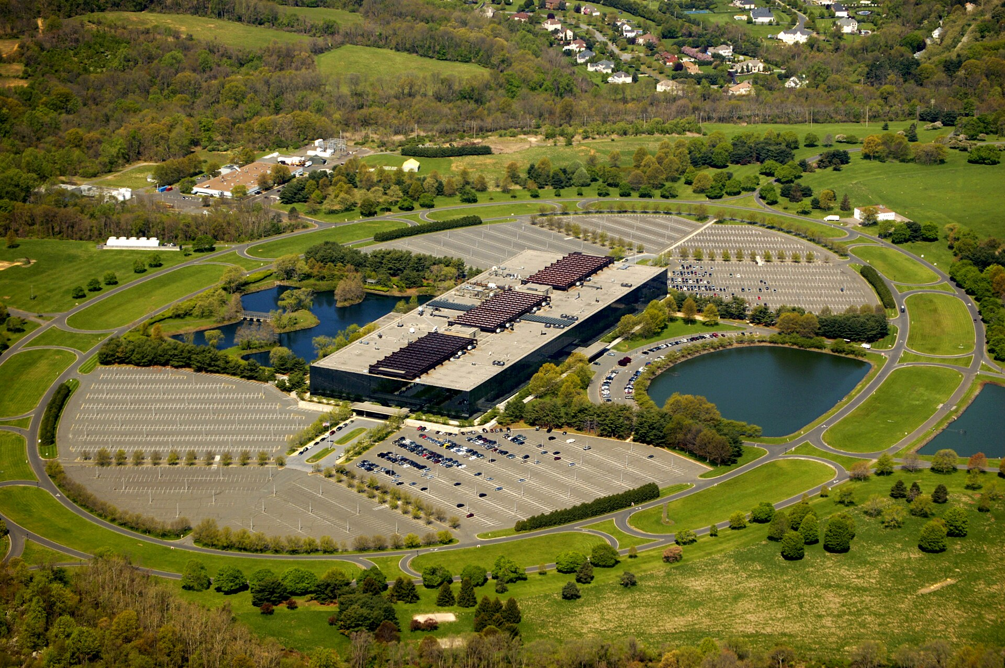
Anyone who watched the series Severance may recognize the huge mirrored block in Holmdel, New Jersey. In the fiction, it becomes Lumon's unsettling headquarters. In real life, that building was one of the great addresses of American industrial research. There and on other Bell Labs campuses, people tried to make a continental telephone network work, reduce noise, understand signals, build electronic components and invent tools for computers that were still rare, expensive and hard to use. The result was an almost absurd concentration of discoveries. The transistor made electronics smaller and more reliable. Claude Shannon explained how to measure information. Penzias and Wilson found an echo of the early universe. Ken Thompson, Dennis Ritchie and their colleagues created Unix; Ritchie developed the C language; Bjarne Stroustrup started what would become C++. Decades later, another team tried to rethink distributed computing with Plan 9. That list is well known. What interests me, though, is the culture that made the list possible.
This text tells some of those stories without turning Bell Labs into an infallible temple. The lab existed inside a powerful corporation, sustained by a regulated monopoly, cut through by wars, disputes over credit, commercial priorities and the inequalities of its time. Even so, there's a fertile lesson in the way fundamental science, practical engineering and intellectual freedom could share the same hallway.
In the end, I want to get to a more modest and very current question: how do we build, today, a small place on the network where people come in, get an account, find tools, talk, publish and learn from each other? That place has an old name, pubnix. Before introducing it, it's worth knowing the lineage of ideas it belongs to.
Before computers, there was a network #
Bell Labs wasn't born to invent personal computers, elegant languages or theories about the universe. It was born because large-scale telephony is a scientific problem disguised as an everyday service. A call had to cross wires, amplifiers, exchanges, cities and continents. Each step added distortion, delay and noise. To deliver the simple experience of hearing someone far away, you had to master materials, acoustics, electronics, mathematics, transmission and manufacturing. In 1925, AT&T and Western Electric organized Bell Telephone Laboratories as a separate company. It started with about four thousand scientists and engineers, according to the institutional history kept today by Nokia Bell Labs. It was the research and development arm of the Bell System, the vast structure that controlled a good part of American telephony. The mission had two horizons: fix tomorrow's problems and discover what might be useful twenty years from now.
That combination matters. Basic research with no contact with the world can lose direction; engineering pressured only by the next quarter tends to repeat what already exists. Bell Labs brought the two extremes together. A physicist could study properties of matter because, at some point, that might produce a better component. An engineer could chase a strange defect in a line and end up facing a fundamental question about signals.
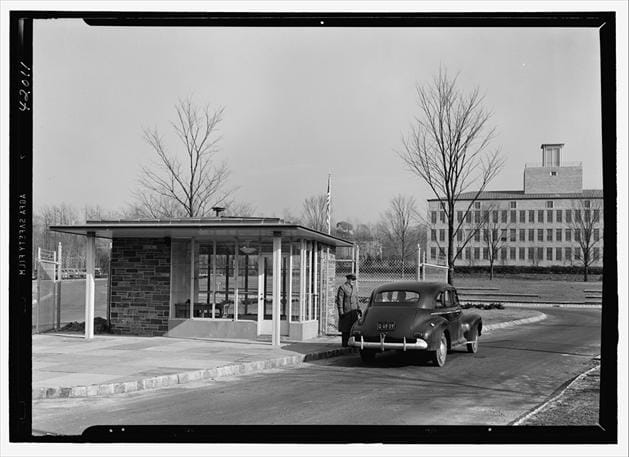
Entrance to the Murray Hill laboratory in 1942. Photo by Samuel H. Gottscho, Library of Congress collection, public domain. Source and license
The buildings where ideas met #
The first big headquarters was on West Street, in Manhattan, in an industrial building packed with labs. Later, Murray Hill, in New Jersey, became the address most associated with the discoveries in physics and computing. Holmdel, designed by Eero Saarinen and built between the late 1950s and the 1960s, looked like a horizontal ship of dark glass landed in a field. Long hallways and common areas increased the chance of encounters between specialties. Architecture alone doesn't produce ideas. But it can favor a certain kind of accident. Mervin Kelly, a researcher and later president of the labs, argued for putting people who didn't speak the same technical language close together. A metallurgy problem could end up on a chemist's desk; a mathematician could explain to an engineer why a system was failing. The doors didn't erase hierarchies, but the hallways created shortcuts.
There was also time. Projects could survive without an immediate commercial justification because the phone network, protected and regulated, generated predictable revenue. That model can hardly be copied today, and there was a political price for that stability. Even so, it allowed fundamental questions to be treated as part of the infrastructure, not as a luxury.
INFORMATION
Claude Shannon puts a measure on the invisible #
In 1948, Claude Shannon published A Mathematical Theory of Communication in the Bell System Technical Journal. The title seemed narrow; the consequence was immense. Shannon separated information from meaning and showed how to treat it mathematically. For a network, it hardly matters whether the message is a declaration of love or a stock quote. The technical problem is representing symbols, carrying them through a channel subject to noise and rebuilding them with an acceptable error rate.
The unit that caught on was the bit, a choice between two possibilities. The theory set limits for compression and reliable communication and provided a grammar for everything that came after: modems, disks, networks, digital video, cell phones, applied cryptography and the internet itself. Shannon didn't build all of those things. He did something perhaps more powerful: he showed where the limits were and gave engineers a ruler. His figure fits Bell Labs mythology perfectly. Shannon built chess machines, a mechanical mouse that could learn a maze and juggling contraptions. He rode down the hallways on a unicycle. These stories aren't just charming eccentricities. They reveal a physical, playful relationship with ideas. For him, thinking also meant making objects that made a concept visible.
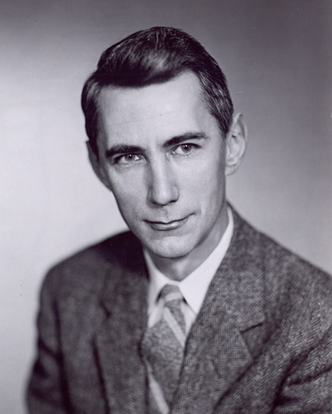
Claude Shannon, author of the mathematical theory of communication. Tekniska museet collection, CC BY 2.0 license. Source and license
There's a design lesson in this story. Good abstractions don't hide the world; they separate the essential from the accidental. Shannon didn't need to understand the content of each message to say something profound about all of them. Decades of software would be built with the same gesture: finding an interface small enough to be general and concrete enough to work.
MATTER
The transistor and the fight for recognition #
At the end of 1947, John Bardeen and Walter Brattain demonstrated the point-contact transistor. William Shockley, who led the group, developed shortly after the theory and design of the junction transistor. The new component could amplify and switch signals without relying on the big, hot, fragile vacuum tubes used until then. In 1956, the three shared the Nobel Prize in Physics for their research on semiconductors and the discovery of the transistor effect.
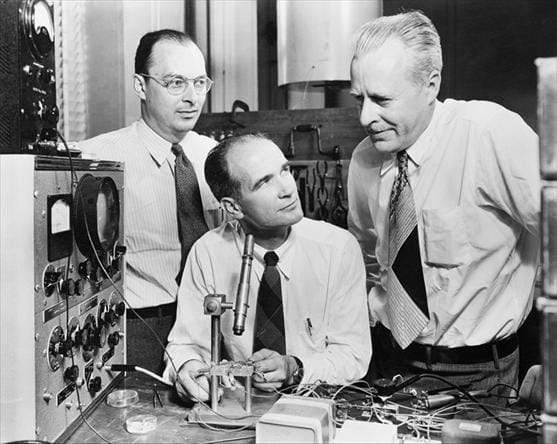
John Bardeen, William Shockley and Walter Brattain in a 1948 Bell Telephone Laboratories promotional photograph. Public domain. Source and license
The official picture of the three men gathered around the equipment suggests harmony. The story was rougher. There was secrecy, internal competition and disagreement about credit and patents. Shockley felt left out of the first demonstration; Bardeen and Brattain resented his attempt to take the center of the narrative. The lab produced collaboration, but it didn't suspend ego, power or ambition. That tension helps avoid a childish version of innovation. Discoveries rarely come from a lone hero and rarely belong, without conflict, to a perfectly aligned team. The transistor depended on quantum theory, purer crystals, manufacturing techniques, instruments and many earlier attempts. Bell Labs brought that chain together in one environment. The photograph is true, but incomplete.
The effect of the transistor quickly escaped telephony. Without it there would be no integrated circuits as we know them, no microprocessors, personal computers or compact servers. What started as a better way to amplify signals became the basic brick of digital civilization.
COSMOS
The noise that came from the beginning of the universe #
In 1964, Arno Penzias and Robert Wilson were trying to use a large horn antenna in Holmdel for radio astronomy and satellite communications. A microwave noise showed up in every direction. They checked the receiver, considered urban interference and cleaned out of the antenna the material left by pigeons. The hiss continued. A few kilometers away, in Princeton, a team led by Robert Dicke was preparing an experiment to look for the radiation predicted by models of a hot, dense universe. The meeting between the two groups revealed what the antenna was hearing: the cosmic microwave background radiation, light cooled by the expansion of the universe over billions of years. It was one of the decisive pieces of evidence for the Big Bang model.
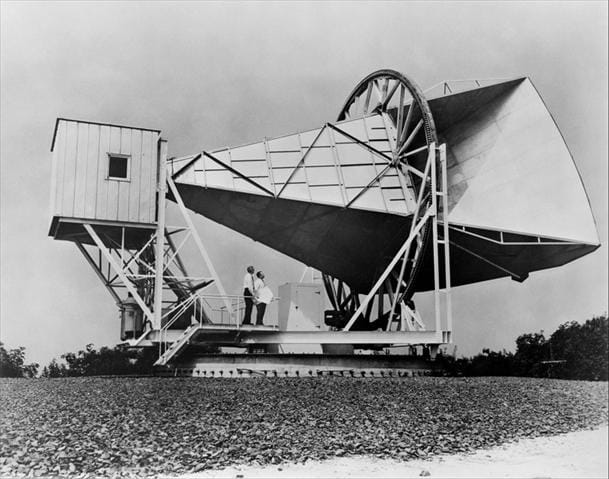
The Holmdel horn antenna used by Arno Penzias and Robert Wilson. NASA image, public domain; restoration by Bammesk. Source and license
Penzias and Wilson received half of the 1978 Nobel Prize in Physics for the discovery. The pigeon story became popular because it's funny, but the most interesting point is about method. They didn't dismiss the noise as a nuisance. They tried to explain every possible source, held on to the strange result and talked to people who had another hypothesis. An apparent defect in the instrument became a window onto the origin of the cosmos.
Bell Labs could reach that kind of discovery because communication instruments and scientific instruments were sometimes the same thing. To talk to a satellite, you had to learn to hear signals almost buried in noise. By perfecting that listening, the lab ended up hearing the universe.
SOFTWARE
Unix is born from the leftovers of another project #
In the late 1960s, Bell Labs took part in Multics, an ambitious time-sharing system project with MIT and General Electric. The promise was to create a kind of public computing utility: many users, memory protection, organized files, programs always available. The project moved forward, but it became expensive and complex. Bell Labs pulled out in 1969. Ken Thompson missed that interactive environment. On a little-used PDP-7 computer, he started putting together a smaller system. A game called Space Travel helped bring him to the machine and served as a lab for tools, but saying Unix was created just to play games is oversimplifying. Thompson already carried ideas about processes, files and interactive programming that had matured in Multics. Dennis Ritchie, Rudd Canaday and other colleagues joined the work. Brian Kernighan suggested the name Unix, a joke on Multics.
The system grew without any grand product plan. One of the first internal justifications was preparing text for a patent application. That's almost comical: a tool that would change computing earned its place because it was good at typesetting documents. Unix survived because it was useful to its own authors and their close colleagues.
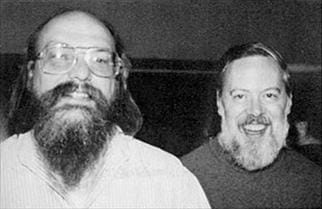
Ken Thompson and Dennis Ritchie in 1973. Unidentified photographer; image reproduced in the Jargon File and listed as public domain on Wikimedia Commons. Source and license
The philosophy of small tools #
Unix treated many resources as files and made text the material programs used to exchange data. Instead of one huge application for each task, it favored small tools that could be combined. One program selects lines, another sorts, another counts, another formats. Pipes, championed by Doug McIlroy and implemented by Thompson, made it possible to connect one process's output to the next one's input. The strength of that idea isn't in each command on its own. It's in the space between them. When the interfaces are simple, the user stops being just a consumer and becomes an author of combinations. The shell is a workshop. A one-line pipeline can be thrown away, shared with a friend or mature into a program.
It was also a multi-user system from the start. Accounts, permissions, processes and home directories weren't added later as social features; they were part of the way expensive computers were lived in. Several people occupied the same machine without being in the same process. That technical coexistence is the direct ancestor of the kind of experience a pubnix tries to recover on a community scale.
C makes the system portable #
The first Unix was written in assembly. That tied it to the machine. Ritchie developed C from the BCPL and B languages, balancing direct memory access with more expressive structures. In 1973, the Unix kernel was rewritten mostly in C. The system stopped being a creature inseparable from the PDP-11 and could cross architectures with reasonable effort.
C didn't eliminate risk. Pointers, memory limits and undefined behavior gave programmers as much power as responsibility. Even so, the language found a rare sweet spot: small enough to understand, close enough to the hardware to write an operating system and general enough to produce an immense variety of software. The success of C and Unix turned each into an advertisement for the other. Universities received versions of Unix with source code and trained generations of programmers who read the system the way you study an organism. Commercial and academic variants multiplied. BSD, the proprietary systems, Linux and the modern family of Unix-inspired systems inherited different parts of that culture. The internet was built, to a great extent, on machines that spoke that language.
OTHER FUTURES
An invention factory that doesn't fit in a list #
The transistor, Shannon and Unix would be enough to make any institution famous. Bell Labs still took part in a disconcerting number of other futures. In 1954, Daryl Chapin, Calvin Fuller and Gerald Pearson presented a practical silicon solar cell. Its efficiency was modest by today's standards, but it showed that light could generate electricity in a useful and lasting way.
Arthur Schawlow, then at the lab, and Charles Townes formulated principles of the optical maser that helped open the way to the laser. It's more accurate to speak of an international chain of contributions than to credit the invention to a single place; Theodore Maiman built the first working laser in another lab. Bell Labs, though, played a central role in the theory and in many later developments.
In 1962, Telstar 1 transmitted television, voice and data signals across the Atlantic and turned satellite communication into a public experience. In 1969, Willard Boyle and George Smith conceived the charge-coupled device, the CCD, which would become fundamental to digital cameras and scientific instruments. Ideas about cells and frequency reuse helped shape mobile telephony. Max Mathews opened paths for computer-generated music. The labs crossed into art as well. In 1966, the engineer Billy Klüver and the artist Robert Rauschenberg organized 9 Evenings: Theatre and Engineering, with artists, dancers and dozens of engineers. Projections, sensors, wireless sound and radio-controlled platforms took the stage before that vocabulary became routine in digital installations. Technology appeared not only as a product, but as a new expressive material.
Erna Schneider Hoover offers another essential story. Realizing that computerized telephone exchanges could collapse during call peaks, she devised a method for the system to prioritize the input and output tasks that kept the service alive. The solution was patented and became important for electronic switching. Her path is also a reminder that the best-known Bell Labs narrative, dominated by photographs of white men, doesn't cover everyone who worked there, nor the barriers other people had to get past.
A very short chronology #
Year
What happened
1925
Bell Telephone Laboratories is organized as a research and engineering company.
1947
Bardeen and Brattain demonstrate the point-contact transistor; Shockley advances the junction transistor.
1948
Claude Shannon publishes the mathematical theory of communication.
1954
Chapin, Fuller and Pearson present a practical silicon solar cell.
1962
Telstar 1 carries television, voice and data across the Atlantic.
1964
Penzias and Wilson detect the cosmic microwave background radiation.
1969
Ken Thompson starts Unix on the PDP-7, with Dennis Ritchie and other colleagues.
1972–73
The C language takes shape and Unix is rewritten mostly in it.
1979
Bjarne Stroustrup starts C with Classes, the embryo of C++.
1984
The breakup of the Bell System splits off part of the research and changes the institutional environment.
Late 1980s
Plan 9 begins development as a new exploration of Unix's distributed ideas.
1996–2016
Bell Labs passes through Lucent, Alcatel-Lucent and, finally, Nokia.
2021
Plan 9's historical code is relicensed under the MIT license.
By 2028
Nokia plans to move the main Murray Hill operation to New Brunswick, New Jersey.
LANGUAGES
C++ and the descendants of Unix #
In April 1979, Bjarne Stroustrup started at Bell Labs a language he called C with Classes. He wanted to keep the efficiency and system access C offered, but add abstraction features he had come to know in Simula. The name C++ came later. The language grew, was standardized and came to hold up operating systems, games, browsers, financial applications and countless programs where performance matters.
C++ represents a different answer from Unix's original one. Instead of keeping every idea exposed in a few constructs, it offers many ways to create abstractions without giving up low-level control. That richness charges a price in complexity, but it showed how the Bell Labs environment kept producing not just products, but instruments others would use to build products. In the same lineage come tools less famous outside the Unix community: awk, created by Alfred Aho, Peter Weinberger and Brian Kernighan; the family of shells; troff and its relatives; control systems and languages that moved between research and production. The culture valued programs that explained themselves through a small interface, plain documentation and code colleagues could read.
AFTER UNIX
Plan 9 puts the network inside the system #
In the late 1980s, Bell Labs researchers started asking what they would do if they could redesign a distributed operating system after learning from two decades of Unix. The result was Plan 9 from Bell Labs, a name taken from Ed Wood's cult film. The joke in the name hid a rigorous proposal: make the network a normal part of the system, without the collection of patches that had grown around Unix. The phrase everything is a file, often used to explain Unix, gets a more consistent application in Plan 9. Services present interfaces similar to file systems. The 9P protocol carries those operations over the network. Processes can have their own namespaces, mounting local and remote resources in places each user chooses. Instead of one global, rigid tree for the whole machine, each environment can build its own view.
A typical session could involve a terminal for the interface, a CPU server to run heavy tasks and a file server to keep data. The distinction didn't need to dominate the experience. A resource available on another computer could show up in the namespace as if it were close by. The design anticipated a world of connected devices and services, but with a uniformity that today's web and clouds rarely offer.
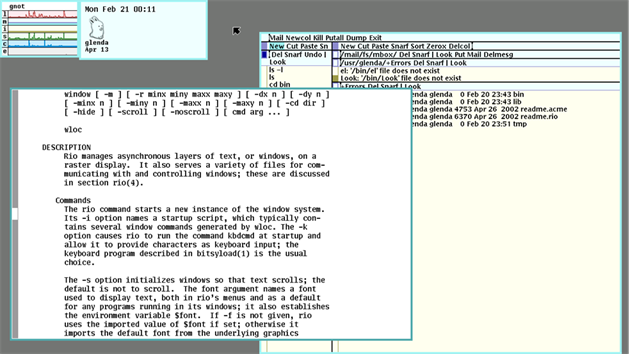
The rio window manager in Plan 9 Fourth Edition. Screenshot by VulcanSphere; the historical Plan 9 software is under the MIT license. Source and license
Plan 9 never replaced Unix. Hardware, applications, habits and compatibility formed a mountain that architectural elegance couldn't move. But its ideas traveled. 9P showed up in virtualization, containers and research projects; namespaces influenced the way we think about isolation; UTF-8 was created by Rob Pike and Ken Thompson during that period and is today the dominant encoding on the web. In 2021, the system's historical code was placed under the MIT license by the Plan 9 Foundation, making preservation and experimentation easier.
There's beauty in Plan 9's almost rough interface. It doesn't try to hide that the computer is a set of tools. rio uses the mouse in its own way, Acme mixes editor, shell and hypertext, and the system invites the user to understand its pieces. It can feel strange to someone coming from a modern desktop, but the strangeness is productive: it shows that current conventions aren't laws of nature.
The price and the limits of the idea factory #
It's tempting to sum up Bell Labs as proof that all you need is to hire geniuses and let them play. The real explanation is more material. The Bell System controlled a huge regulated network and had the obligation to make it work for decades. Long-term research was insurance against future problems, a source of patents and an instrument of prestige. The company's scale funded equipment, libraries, workshops and stable careers.
The same arrangement concentrated economic power. The US government sued AT&T for anticompetitive practices, and the reorganization that took effect in 1984 broke the system up. Part of the research tied to the regional operating companies went to Bellcore. In 1996, AT&T spun off Lucent, which took Bell Labs with it. Lucent merged with Alcatel in 2006; Nokia acquired Alcatel-Lucent in 2016.
The name survives, the research continues and Nokia itself counts ten Nobel Prizes and five Turing Awards tied to the lab. But the institutional world changed. Murray Hill, a historic address since the 1940s, is set to give way by 2028 to a new facility in New Brunswick. Holmdel had already been turned into Bell Works, a complex of offices, shops and events. Buildings can be preserved; the economic model that brought them to life is harder.
It's also not wise to confuse internal freedom with automatic public openness. Unix circulated in universities, but licenses and commercial disputes limited its use in several periods. The open culture we associate with Unix's descendants was built by universities, communities, free software projects and independent networks, often negotiating with or reacting to corporate interests.
Bell Labs' best legacy isn't a ready-made business recipe. It's a set of questions. Are we giving deep problems time? Can people from different fields meet? Are tools made only for customers, or also to expand the autonomy of those who use them? Can knowledge escape the building and come alive elsewhere?